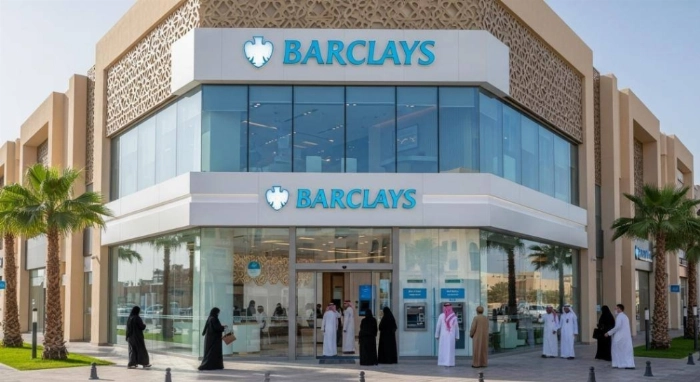
Global banks and financial institutions are expanding in Saudi Arabia. Some are setting up regional headquarters that run management and strategy across the region. Others are opening branches or banking and financial entities that serve clients inside the Saudi market. Barclays’ new office at the King Abdullah Financial District (KAFD) in Riyadh is the latest step in this trend.
Barclays: the latest arrival
On Monday, Barclays announced that it had opened its office after the Capital Market Authority (CMA) gave it an operating licence for investment banking and global markets. This follows the regional headquarters licence it received in 2025. The bank aims to expand its financial advisory and capital markets services to corporates, government entities and institutions.
Barclays is not the only one expanding. Other international financial institutions have also been licensed to set up regional headquarters in Riyadh, including Goldman Sachs, Morgan Stanley, Citi, BNY, Deutsche Bank and J.P. Morgan. Citi opened its regional headquarters in Kingdom Tower in October 2025, and Deutsche Bank received its regional headquarters licence in July 2026.
Regional headquarters vs. bank branches
The two are different kinds of presence. A regional headquarters usually handles management, coordination, strategic planning and corporate functions for the bank’s operations across a wider area, and does not necessarily provide banking services directly to clients. A bank branch operates under a licence to conduct banking business in the Kingdom, within the scope of activities approved by the Saudi Central Bank (SAMA).
Linking the local market to global markets
These institutions matter because they connect local companies and entities with global financial markets. They advise on mergers and acquisitions, arrange debt and equity issuances, and provide financing, asset management and custody services for institutional investors. A local presence also lets them build closer relationships with government entities and companies, understand what the market needs, and take part in financing major projects and transactions.
The growing international financial presence reflects the Kingdom’s importance as an investment market and a regional business hub. However, it does not mean every institution runs its regional operations from Riyadh. Some focus on the domestic market, while regional headquarters may cover the Middle East or a wider region, depending on each institution’s licence and operating structure.
Expansion despite geopolitical tensions
These moves carry added weight given the security tensions in the region. Saudi Arabia faces Houthi terrorist attacks that attempt to target its economic infrastructure. Even so, global companies keep expanding their economic presence in the Kingdom through branches, regional headquarters and foreign investment. This reflects global confidence in the Kingdom’s economic resilience, even in times of crisis. Saudi Arabia’s widely recognised handling of the COVID-19 pandemic earned it experience and international credibility as a model of economic resilience.
Investment growth strengthens market appeal
According to the General Authority for Statistics (GASTAT), foreign direct investment inflows into the Kingdom rose 33.5% in 2025 to around SAR 159.1 billion. The stock of foreign investment grew to about SAR 1.06 trillion.
Regional headquarters of international financial institutions
- Barclays
- Goldman Sachs
- Morgan Stanley
- Citi
- BNY
- Deutsche Bank
- J.P. Morgan
- HSBC
Foreign banks with operating branches in H1 2026 data
- Emirates NBD
- First Abu Dhabi Bank
- National Bank of Kuwait
- Industrial and Commercial Bank of China (ICBC)
- Qatar National Bank
- BNP Paribas
- Deutsche Bank
- Bank Muscat
- National Bank of Bahrain
- JPMorgan Chase
- National Bank of Pakistan
- Ziraat Bank
- MUFG
- UBS
- Standard Chartered
- National Bank of Iraq
- Sohar International
- National Bank of Egypt
- Abu Dhabi Commercial Bank
- Bank of China